News
My Arcade Gamestation Retro Go Pre-Orders Open at $199.99
The 8-inch retro handheld packs more than 200 licensed games, SmartGlow controls, Wi-Fi and HDMI output, with US pre-orders now open.
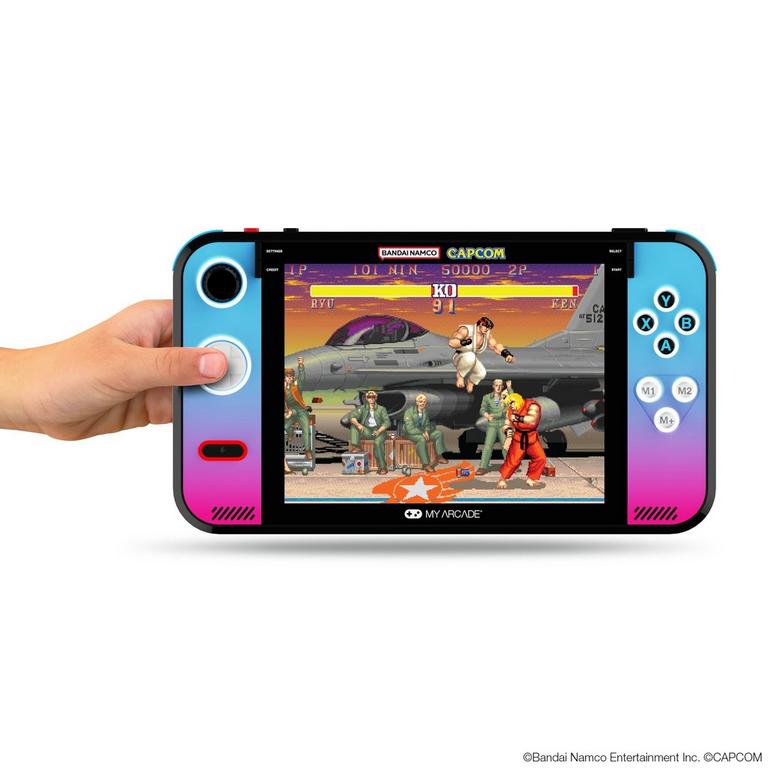
My Arcade has opened pre-orders for the Gamestation Retro Go, a licensed retro handheld that bundles more than 200 games from Bandai Namco, Capcom, Jaleco and PIKO Interactive. GameStop lists the system at $199.99, with release-day pickup described for the pre-order, while reporting around the listing points to an October 31, 2026 launch.
A bigger screen and a broader game library
The Retro Go is not the same machine as My Arcade's Atari-focused Gamestation Go. Its most obvious change is the display: the new model uses an 8-inch high-resolution full-colour screen, compared with the 7-inch panel on the Atari Gamestation Go. More importantly, the software pitch is built around several licensed publishers rather than a predominantly Atari-led catalogue.
My Arcade originally announced the Gamestation Retro family in early 2025 with more than 100 games planned. The current GameStop listing now promises more than 200 built-in titles. The retailer specifically names Bandai Namco and Capcom as headline partners, alongside licensed games from Jaleco and PIKO Interactive.
- More than 200 built-in licensed games
- 8-inch high-resolution full-colour display
- SmartGlow controls that illuminate the buttons needed for each game
- Built-in Wi-Fi for updates
- Game-save support
- Rechargeable internal battery
- HDMI output for playing on a television
- HDMI cable, charging cable and 100/240V AC adapter included
SmartGlow is the unusual hardware feature
SmartGlow is one of the more distinctive ideas in the specification sheet. Rather than leaving every control equally prominent, the system can illuminate the controls required by the game being played. That could be useful on a device spanning arcade and console releases with different layouts, although TechCravers has not tested the handheld and cannot judge how useful the feature is in practice.
The system also includes Wi-Fi for updates and supports game saves, two conveniences that make it less like a basic plug-and-play novelty. HDMI output means the same built-in library can be moved to a larger display. GameStop says an HDMI cable is included in the box, along with the charging cable and a universal-voltage AC adapter.
What games are included?
A complete 200-plus-game list was not available in the sources checked for this story. My Arcade's original announcement did, however, name Pac-Man, Galaga, Pole Position and Dig Dug from the Bandai Namco side, together with Capcom games including Street Fighter II, Mega Man, Final Fight and 1942. Those titles established the direction of the collection, but buyers should wait for the final published library before assuming every previously announced game remains included.
Price and availability
GameStop currently lists the Gamestation Retro Go for pre-order at $199.99. The retailer page confirms the price and pre-order status, while My Arcade's September 2 social announcement, reproduced by specialist coverage, says the handheld is available to pre-order at GameStop. Multiple reports give October 31, 2026 as the release date.
No verified Swedish price or Swedish retail availability was found at the time of writing, so the US price should not be treated as a direct indication of what the handheld would cost in Sweden after tax, distribution and currency differences.
A licensed alternative in a crowded retro market
The Gamestation Retro Go's appeal is straightforward: a large handheld screen, a legally licensed multi-publisher catalogue and TV output in one self-contained device. It is also arriving at a higher US price than many small retro handhelds, making the exact game list and the quality of the software implementation important details.
For now, the confirmed story is about specifications and pre-orders rather than performance. There are no TechCravers hands-on results behind this article, so display quality, controls, battery life, emulation behaviour and overall value remain open questions until the finished hardware can be independently evaluated.