ReviewHardwareReviews
Anbernic RG DS Plus Review: A Better DS Handheld by Doing Less
Sharper dual screens, a much better hinge and a built-in stylus make the RG DS Plus a stronger Nintendo DS handheld, even as Anbernic cuts RAM, Android and a second analog stick.
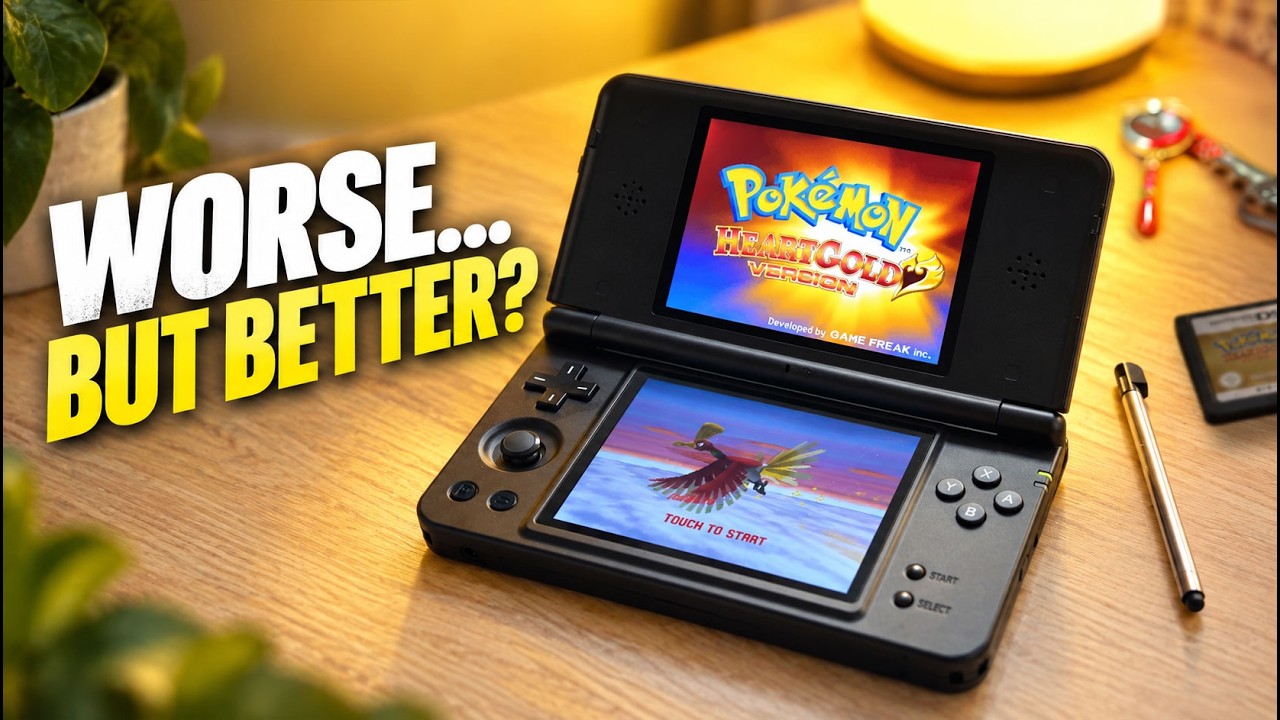
The Anbernic RG DS Plus is a strange kind of upgrade. It keeps the same RK3568 processor as the original RG DS, drops from 3GB of RAM to 1GB, removes Android, internal eMMC storage and one analog stick — yet after spending more than a week with it, those cuts make more sense than the spec sheet suggests. This is a more focused handheld built around one job: Nintendo DS emulation.
The screens are the real upgrade
The biggest change is immediately obvious when you open the clamshell. Anbernic has replaced the original model’s 4-inch 640×480 panels with two 4.3-inch IPS displays running at 1024×768. Because the Nintendo DS originally rendered at 256×192, that gives the RG DS Plus a perfect 4× integer scale in both directions. DS games look exceptionally clean, with sharp pixel art and two matching displays that make the whole experience feel cohesive.
The larger screens also explain some of the extra bulk. The RG DS Plus is chunky, but its more rounded shell and matte finish feel refined in the hand. The black review unit also does a much better job of hiding fingerprints than the glossy original.
- Displays
- Dual 4.3-inch IPS, 1024×768
- Processor
- Rockchip RK3568, quad-core Cortex-A55 up to 2.0GHz
- RAM
- 1GB
- Operating system
- Linux
- Wireless
- 2.4/5GHz Wi-Fi, Bluetooth 4.2
- Battery
- 4,000mAh
- Storage
- 16GB OS microSD; second microSD slot for games
- Ports
- 2× USB-C, 3.5mm headphone jack, 2× microSD
A better hinge, controls and stylus
Anbernic has made several smaller changes that suit the DS focus. The D-pad and ABXY buttons use tactile metal-dome switches and feel clicky and precise, while the smaller Start and Select buttons look more at home on a DS-style device. There is now only one analog stick, but for Nintendo DS games that rarely feels like a meaningful loss.
The redesigned hinge is one of the strongest physical improvements. Rather than clicking between a few fixed positions, it offers near-continuous adjustment and holds the screens securely at the chosen angle. It feels robust and helps the whole handheld feel more solid.
The stylus finally has a proper home inside the shell, too. It is a comfortable size and works well for tapping and navigation, although its rubber tip creates more friction against the glass than I would like when dragging across the touchscreen. A smoother tip would have made stylus-heavy games feel more natural.
Linux keeps things simple, but updates do not
Unlike the original RG DS, the Plus is Linux-only. Nintendo DS games get their own prominent section, while other systems sit under RetroArch. The RK3568 still has enough performance for the usual 8- and 16-bit platforms through PlayStation, with some N64 and Dreamcast games possible depending on the title, but that broader emulation support is not the reason to buy this machine.
DS games use Anbernic’s NDS emulator, which is intentionally basic but includes essentials such as save states, fast-forwarding, shaders and configuration options. During the review period, two emulator updates arrived with noticeable performance and quality-of-life improvements. The frustrating part is delivery: despite having Wi-Fi, the unit did not offer an over-the-air updater, so updates had to be downloaded separately and copied manually to the OS card.
The downgrades make sense — mostly
Calling this a “Plus” is misleading if you expect more raw capability. The processor is unchanged, RAM falls from 3GB to 1GB, the original model’s 32GB eMMC storage is gone, Android has disappeared and there is one fewer analog stick. As an all-round emulation handheld, that is undeniably a reduction in versatility.
For DS emulation, however, those omissions rarely got in the way. The sharper displays, stronger hinge and integrated stylus affect the experience far more directly than extra RAM or a second stick. That makes the RG DS Plus feel less like a conventional upgrade and more like Anbernic correcting the priorities of the original design.
Price and verdict
Anbernic currently lists the base 16GB RG DS Plus at $94.99, which keeps it below $100 and makes the value proposition particularly strong for anyone primarily interested in Nintendo DS games. The base configuration is also the sensible choice if you plan to supply a good-quality microSD card for your own dumped games.
Battery life could be better, the manual update process needs work, and Anbernic’s DS emulator still has room to mature. But as a dedicated DS-style handheld, the RG DS Plus gets the important parts right. The dual 1024×768 displays are the standout feature, the hinge and built-in stylus make the hardware feel purpose-built, and the stripped-back design ultimately feels more coherent than the original. It gives up versatility to become a better Nintendo DS machine, and that trade is easy to accept if DS is what you actually want to play.
Where to find it
TechCravers verdict
RG DS Plus
The RG DS Plus is not a conventional spec upgrade, but it is a much better-focused Nintendo DS handheld. Its sharp 4×-scaling displays, sturdy hinge and integrated stylus matter more in daily DS use than the RAM, Android support and second analog stick it gives up. The software and update process still need refinement, but at $94.99 it is an easy handheld to like if Nintendo DS is the priority.
What we like
- Excellent dual 1024×768 displays for 4× Nintendo DS integer scaling
- Robust continuously adjustable hinge
- Built-in stylus is much more convenient
- Focused Linux experience is simple to use
- Strong value at under $100
What we don't
- Less RAM, no Android and no internal eMMC storage compared with the original RG DS
- No over-the-air update system during the review period
- Stylus tip has more screen friction than ideal
- Battery life could be better
Sources
About the author
TechCravers
Writes about consumer technology and gaming for TechCravers.